Mental health challenges?
We can help
Transcranial Magnetic Stimulation (TMS) is a non-drug treatment for depression, depression with anxiety and OCD. The Neil S. Hirsch TMS Center uses the NeuroStar Advanced Treatment system to deliver TMS to people in and around West Palm Beach.
Measurable Improvement
A real-world study reported an 83% response rate. This means that 83% of people who completed their TMS treatment cycle saw measurable improvement in their depression symptoms.**12
Achieved Complete Remission
The same real-world study reported a 62% remission rate. This means that 62% of people who completed their TMS treatment cycle likely wouldn’t be diagnosed with MDD if they were first being evaluated by their doctor.**12
Remission Rate Without TMS
By comparison, in a separate study not involving TMS, for people who have not found relief from 3 or more antidepressants, the chance of remission from subsequent medications is less than 7%.6,7,17,18
What is TMS?
Transcranial Magnetic Stimulation (TMS), a non-drug treatment for Major Depressive Disorder, Major Depressive Disorder with anxiety and an adjunct treatment for Obsessive-Compulsive Disorder (OCD). TMS uses focused magnetic pulses to help your brain function the way it was meant to.
TMS treatment is not a drug, “shock therapy”, or surgery. It is a non-invasive, FDA-cleared treatment that is generally well-tolerated without the side effects of medication.
FDA-Cleared
This well-tolerated treatment meets rigorous federal standards.
Medication Free
People can benefit without the side effects or dependency risks often associated with medications.
Non-Invasive
TMS stimulates targeted areas of the brain using magnetic pulses without surgery or anesthesia.
Evidence Based Treatment
Backed by clinical research, TMS uses FDA-cleared methods to help improve mental health outcomes
Is TMS Treatment Right for Me?
TMS may be right for you if you agree with two or more:
- Depression/OCD/Anxiety symptoms have interfered with my daily life.
- I am not satisfied with the results I get from medication.
- I have had or worry about side effects from medications.
- I am interested in a non-invasive, non-drug treatment.
While medications work for many people, some people still do not feel relief. For hard to treat conditions where medication is not giving you adequate relief, TMS Treatment is a FDA-cleared, non-invasive treatment option.
The Neil S. Hirsch TMS Center was established with support from the Neil S. Hirsch Foundation, made possible through FACTMS (Foundation for the Advancement of Clinical TMS).
What are TMS Treatments Like?
1
Before Treatment
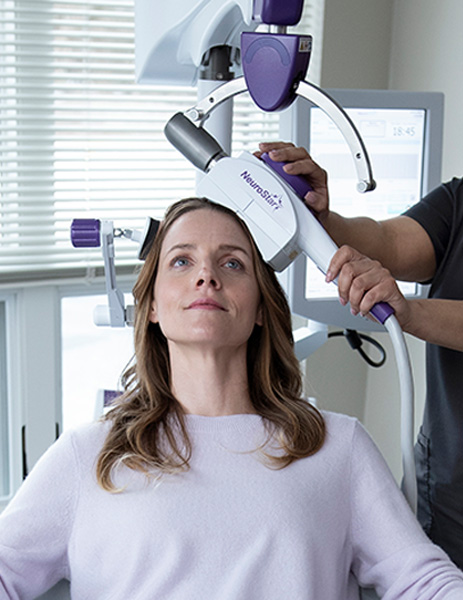
You’ll recline comfortably in the treatment chair. A small, curved magnetic coil will be positioned lightly on your head.
2
During Treatment
TMS Treatment uses magnetic pulses to help people find relief from their depression, anxiety and/or OCD symptoms. TMS is non-systemic, and does not include the use of medications or antidepressants.
3
After Treatment
Each treatment takes approximately 20 minutes. You can resume normal activities immediately. Because there are no effects on alertness or memory, you can drive yourself to and from treatment sessions.
What People Say About Alpert JFS
Incredible organization making a difference in the lives of so many. Ms. Jenny and the team are so kindhearted, and it is a true pleasure to have met them.
Leon F.
The services provided by Alpert Jewish Family & Children's Services are astounding in scope and that is why it is so impressive to see how well the agency works for the betterment of its clients and the community. The ethic and energy is evident upon first contact. The people at Alpert are just fantastic and the professionalism starts at the top.
Scott
Still great after all this time! The services and people are excellent, take it from me. I've been with them for almost 25 years!
Jeffrey
Video Testimonials
Frequently Asked Questions
TMS stands for Transcranial Magnetic Stimulation. TMS uses brief, focused magnetic pulses to stimulate the areas of the brain associated with mood regulation, which tend to show reduced activity in people with depression, anxiety, and OCD.
TMS is for people struggling with mental health challenges like depression, depression with anxiety, and OCD, who may have lost hope. Perhaps they have tried talk therapy, several medications that don’t seem to work, or they can’t tolerate the side effects, TMS provides another option, a new opportunity to be hopeful. For many people, it’s the first treatment that’s actually worked.
You sit in a comfortable chair, awake, and alert. A small device rests against your head and delivers soft magnetic pulses, which most people describe as a tapping sensation on the scalp. A session takes about 20 minutes.
NO. Most people find TMS easy. Some notice scalp discomfort or a mild headache during the first few sessions, and this usually fades as treatment goes on. There’s no anesthesia, no sedation, and no recovery time.
NO. TMS and ECT are very different. TMS uses magnetic pulses while you’re awake and alert, requires no anesthesia, and doesn’t affect memory. You walk in, have your session, and go on with your day.
A full course of TMS is typically about 36 sessions over roughly six weeks, five days a week. Each visit is short, and most people fit sessions around work and daily life.
In published studies, 83% of patients with treatment-resistant depression see a significant reduction in symptoms and about 62% reach remission. [Sackeim HA, et al. (2020). Clinical Outcomes in a Large Registry of Patients with Major Depressive Disorder Treated with Transcranial Magnetic Stimulation. J Affective Disorders, 277(12):65-74. 2020.]
No. TMS works alongside the care you’re already receiving. Many people continue their therapy and medication during treatment.
Alpert JFS believes that cost should never be a barrier to feeling better. Most insurance is accepted, and a sliding fee scale is available. When you call, we’ll walk you through your coverage and your options before anything begins.
Because depression, depression with anxiety, and OCD don’t happen in a vacuum, treatment shouldn’t either. At Alpert JFS, the same call that starts TMS also connects you and your family to counseling, care management, support groups, and help with many of life’s challenges.
The Neil S. Hirsch TMS Center was made possible by a generous donation from the Neil S. Hirsch Foundation through the Foundation for the Advancement of Clinical TMS. The purpose is simple: make TMS available to people who couldn’t otherwise access it.
Call 561-713-1892. Our TMS team will answer your questions to see if TMS is a good fit. If so, we will arrange next steps.
Not Sure if TMS is Right For You? Contact Us to Learn More.
About The Neil S. Hirsch TMS Center At Alpert JFS
Alpert Jewish Family Service (Alpert JFS) is where Palm Beach County turns during life’s challenging times. This nationally accredited, nonsectarian nonprofit serves 12,000 individuals annually with programs including counseling and psychiatry for adults, children, and families, Transcranial Magnetic Stimulation (TMS), Holocaust survivor care, senior homecare, food pantry, mentoring, and supported independent living for adults with special needs.
- 5841 Corporate Way, Suite 200 West Palm Beach, FL 33407
- Phone: 561-713-1892
**Outcomes Registry data was published by Sackeim HA, et al. J Affective Disorders, 2020, 277(12):65-74. The outcomes reported represent the subset of study patients for which the CGI-S data was reported before and after an acute course of NeuroStar TMS. Patients were treated under real-world conditions where patients may have been prescribed concomitant depression treatments including medications. “Measurable relief” was defined as a CGI-S score <=3 and “complete remission” was defined as a CGI-S score <=2 at the end of treatment.
***Patients received more than one course of treatment and were treated with standard of care. Standard of care also included medications. CGI-S represents the scale used to define response and remission.